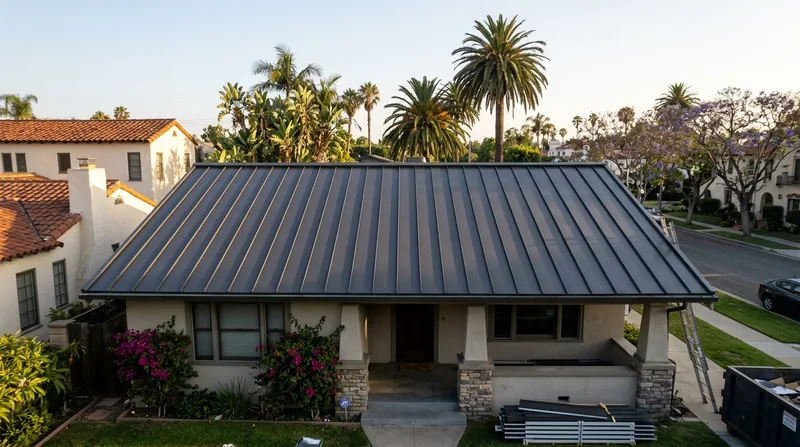




Standing Seam Metal Roofing in Long Beach: Built for Salt Air and Santa Ana Winds
Long Beach sits on the flat coastal plain at the edge of the Pacific, with Signal Hill rising to the north and the harbor to the south. That geography means every roof here faces steady salt-laden air, strong year-round UV, and dry Santa Ana wind events that stress old fasteners. Standing Seam Metal Roofing in Long Beach is the system we recommend when you want concealed fasteners, no exposed screws for the salt air to attack, and a cool reflective finish that handles the coastal sun. From the Craftsman bungalows of Rose Park to the Spanish Colonial Revival homes of Belmont Heights and the waterfront cottages on the Naples canals, we roll-form panels to length and seam them on site. If you are weighing this against other systems, start with our metal roof installation overview, then come back to the standing seam specifics below.
Why Standing Seam Matters for Long Beach Roofs
The building stock here is a mix of 1910s-1930s Craftsman bungalows, steep-gabled Tudor and Spanish cottages in California Heights and Bixby Knolls, 1940s-50s stucco ranch tract homes across Lakewood Village and Los Altos, and newer townhomes near downtown. Most of those roofs were never designed for the combination of salt air and intense UV we get here. Standing seam solves the two failure modes that dominate in this city: fastener corrosion from ocean air and wind uplift at panel edges during Santa Ana events.
- Concealed clips and seams mean no exposed screws for salt air to corrode, which is the number one failure point on older exposed-fastener roofs.
- Mechanically seamed panels resist uplift far better than screw-down panels when Santa Ana gusts hit the ridgelines in California Heights and Bixby Knolls.
- Cool reflective finishes cut attic heat gain during the strong UV months, which matters on the low-pitched ranch roofs of Wrigley and the Eastside.
- Panels roll-formed to length eliminate lap seams, so atmospheric-river rain in January and February has fewer places to find a weak flashing.
- The clean vertical profile suits both the Spanish Colonial Revival homes of Bluff Park and the flat-roofed contemporaries near the harbor.
For homeowners in historic districts and HOA-governed neighborhoods like Naples and Belmont Shore, panel profile and color often need design review approval before we order material.
Key info: A 1920s Spanish cottage in Belmont Heights with a steep gable and clay barrel tile is a common candidate for standing seam. We match the panel profile and color to the neighborhood character, and we confirm historic district or HOA review requirements before the first panel is rolled. The Long Beach Building & Safety Bureau handles roofing permits, and thresholds vary by jurisdiction. Check the city building department for current requirements.
How We Install Standing Seam on a Long Beach Home
Standing seam is not a panel you screw down and walk away from. The performance comes from the substrate, the underlayment, the clip spacing, and the seaming. We start with a tear-off and deck inspection, because on 1940s-50s stucco ranch homes in Lakewood Village and Los Altos we regularly find soft sheathing and old fastener holes that need attention before any metal goes down. Then we roll-form panels to the exact length of each run on site, which means fewer seams and a tighter fit around chimneys, skylights, and valleys.
- We tear off the existing roof and inspect the deck for soft spots, then replace any compromised sheathing.
- We install a high-temperature synthetic underlayment rated for metal roofs and the coastal UV load.
- We set the concealed clip system at the engineered spacing for the panel profile and the local wind zone.
- We roll-form panels to length on site and lift them into place, protecting the finish as we go.
- We mechanically seam or snap-lock each panel, then install ridge caps, eave trim, and all flashing.
- We walk the roof with you, document the installation, and clean the site before we leave.
On the canals of Naples and along Belmont Shore, we often work around tight side-yard access and neighboring waterfront structures, which changes how we stage material and equipment.
Key info: A 1950s ranch home in Los Altos with a low-pitch composition shingle roof is a strong candidate for standing seam, but the low slope means we spec a taller seam profile and tighter clip spacing to handle wind uplift. We also check whether the existing layers allow a recover or require a full tear-off, since code limits how many layers can stay. For homes in the 90804 area, see our standing seam service in 90804.
Standing Seam Approaches We Use in Long Beach
Not every Long Beach roof calls for the same panel. The right approach depends on pitch, wind exposure, budget, and how the roof ties into existing stucco walls and tile details. Here are the main options we install in this city.
| Approach | Description | Best for |
|---|---|---|
| Mechanically seamed | Panels joined with a raised double-lock seam using a powered seamer, with concealed clips. | Steep gables in California Heights and Bixby Knolls where wind uplift matters. |
| Snap-lock | Panels snap together at the seam without a mechanical seamer, concealed fasteners throughout. | Low-pitch ranch roofs in Lakewood Village and Los Altos where budget and speed matter. |
| Standing seam over existing shingles (retrofit) | New subframing and panels installed over a sound existing roof where code allows. | Homes where tear-off cost and disruption are a concern and the existing deck is solid. |
| Standing seam with tile-matching profile | Panel profile and color selected to echo the original clay barrel tile or Spanish character. | Spanish Colonial Revival homes in Belmont Heights, Bluff Park, and Rose Park. |
| Standing seam with integrated gutters | Panels and gutter runs planned together so roof water sheds cleanly during heavy rain. | Waterfront cottages on the Naples canals and Belmont Shore. |
We match the approach to the house, the wind exposure, and the design review requirements, not the other way around.
Standing Seam Metal Roofing Cost in Long Beach: What to Expect
Most homeowners want a number before they commit, and that is fair. Standing seam starts around $10 per square foot installed, but that figure moves based on pitch, panel profile, tear-off, deck repair, and how complex the flashing is around chimneys and skylights. A simple low-pitch ranch roof in Los Altos is a different job than a steep-gabled Tudor in Bixby Knolls with multiple valleys and dormers. For a full breakdown of what drives the number, see our pricing overview.
- Panel profile and seam type change material cost, with mechanically seamed systems running higher than snap-lock.
- Tear-off and deck repair add labor, especially on older stucco ranch homes with soft sheathing.
- Roof complexity (valleys, dormers, chimneys, skylights) adds flashing time and material.
- Access on tight side yards in Naples and Belmont Shore can slow staging and add labor.
- Historic district or HOA design review may require specific colors or profiles that affect lead time.
We recommend getting two or three estimates so you can compare scope, not just price. A low bid that skips deck repair or underlayment is not the same job.
Standing Seam Metal Roofing Near Me: How to Choose a Contractor in Long Beach
Hiring the right contractor matters more than the panel brand. Standing seam lives or dies on clip spacing, seam quality, and flashing detail, and those are labor decisions. Here is what to check before you sign anything in Long Beach or the surrounding cities.
- Confirm the contractor is licensed and insured, and ask for a certificate of insurance before work starts.
- Get at least two or three written estimates with the same scope so you can compare fairly.
- Ask for local references, especially on homes with similar roof pitch and neighborhood design review.
- Understand the permit process with the city building department and whether historic district or HOA review applies.
- Ask how the contractor handles flashing around chimneys and skylights, since that is where leaks start.
If you want to talk through your roof, contact us and we will set up a free on-site estimate.
Standing Seam vs. Exposed Fastener: What Long Beach Homeowners Should Know
Exposed-fastener corrugated and ribbed panels are common on agricultural and commercial buildings, and they have their place. But on a residential roof in Long Beach, every exposed screw is a point where salt air starts corrosion. Standing seam hides the fasteners under the seam, which is why we recommend it for homes in Belmont Shore, Bluff Park, and anywhere within a few miles of the water. If you are comparing systems, our exposed fastener metal roofing page explains the trade-offs.
Standing seam also handles thermal movement better, because the concealed clips allow the panel to expand and contract without backing out fasteners. On a roof that sees strong UV and wide temperature swings, that matters over a 30 to 50 year service life.
Maintenance and Long-Term Care for Standing Seam Roofs in Long Beach
Standing seam is low maintenance, but not no maintenance. Salt air, dust, and debris from ficus and palm trees collect in valleys and behind chimneys, and that is where you will see the first signs of trouble. We recommend a professional inspection every few years, especially after a Santa Ana wind event or a heavy atmospheric-river rain. Our metal roof inspection service covers seams, clips, flashing, and gutters.
If a panel is damaged by wind-blown debris or a falling branch, we can replace individual panels rather than the whole roof, which is one of the advantages of a seamed system. Keep the panel profile and color on file so replacements match.
Neighborhoods We Serve for Standing Seam in Long Beach
We install standing seam across Long Beach and the surrounding cities. That includes Belmont Heights, Bluff Park, Rose Park, Alamitos Heights, California Heights, Bixby Knolls, Naples, Belmont Shore, Lakewood Village, Los Altos, Wrigley, the Eastside, and downtown. We also work in Signal Hill, Lakewood, Bellflower, Paramount, Compton, Carson, Torrance, Lomita, Cerritos, Downey, Seal Beach, Huntington Beach, Los Alamitos, Cypress, and Whittier.
Every neighborhood has its own roof character, and we plan the panel profile and color to fit the house and the block. For a closer look at your area, see our service areas page.
Standing Seam Metal Roofing in Long Beach: Pricing Guide
| Service | Price | Details |
|---|---|---|
| Snap-lock standing seam | Starting at $10/sq ft | Includes panels, concealed clips, underlayment, and standard flashing on a simple low-pitch roof. |
| Mechanically seamed standing seam | Starting at $13/sq ft | Includes powered seaming, engineered clip spacing, and trim on steeper or more wind-exposed roofs. |
| Standing seam over existing shingles (retrofit) | Starting at $11/sq ft | Includes subframing and panels over a sound existing roof where code allows, without tear-off. |
| Complex or large-scale job | On estimate | Multiple valleys, dormers, chimneys, or historic district design review require an on-site look before pricing. |
| Travel | Included | In Long Beach and surrounding cities, no separate call-out or mileage fee is added. |
| Estimate | Free | On-site inspection and written scope within 24 hours at (562) 685-9725, no obligation to book. |
Indicative pricing, the exact cost depends on square footage, finish, and site access. Free personalized estimate within 24h at (562) 685-9725.


